
London Marathon 2026 Course Strategy: Science-Backed Pacing & Biomechanics
The London Marathon is globally renowned for its flat, lightning-fast profile and electric atmosphere. However, beneath its PB-friendly reputation lies a series of subtle physiological traps that can derail even the most meticulously trained athlete. For the 2026 edition, optimizing your performance requires more than just high VO2 max; it demands a deep understanding of how the specific course geometry interacts with your biomechanics, neuromuscular fatigue, and metabolic pathways.
As thousands of runners gather at the historic start lines in Blackheath and Greenwich Park, adrenaline runs exceptionally high. This immediate surge in catecholamines (adrenaline and noradrenaline) can skew your perception of effort, causing an unconscious increase in early pace. Managing this initial neurological spike is critical to preserving your limited muscle glycogen stores for the demanding final miles along the Embankment.
The Early Downhill: Managing Eccentric Muscle Damage in Greenwich
During the first three miles of the London course, runners experience a net descent as the routes from the three distinct starts merge. While downhill running feels metabolically cheap, it imposes a high biomechanical cost. The descent increases the eccentric loading on your quadriceps, where the muscle fibers are forced to lengthen under tension to decelerate your body weight with every stride.
To prevent premature micro-tears in these muscle fibers—which drastically increases ground contact time and degrades running economy later in the race—you must consciously manage your stride dynamics. Instead of overstriding and braking with your heels, focus on maintaining a high cadence and landing with a midfoot strike directly underneath your center of mass. This distributes the impact forces more evenly across the musculoskeletal system, sparing your quads for the flat miles ahead.
The Tower Bridge Adrenaline Trap and Glycogen Sparing
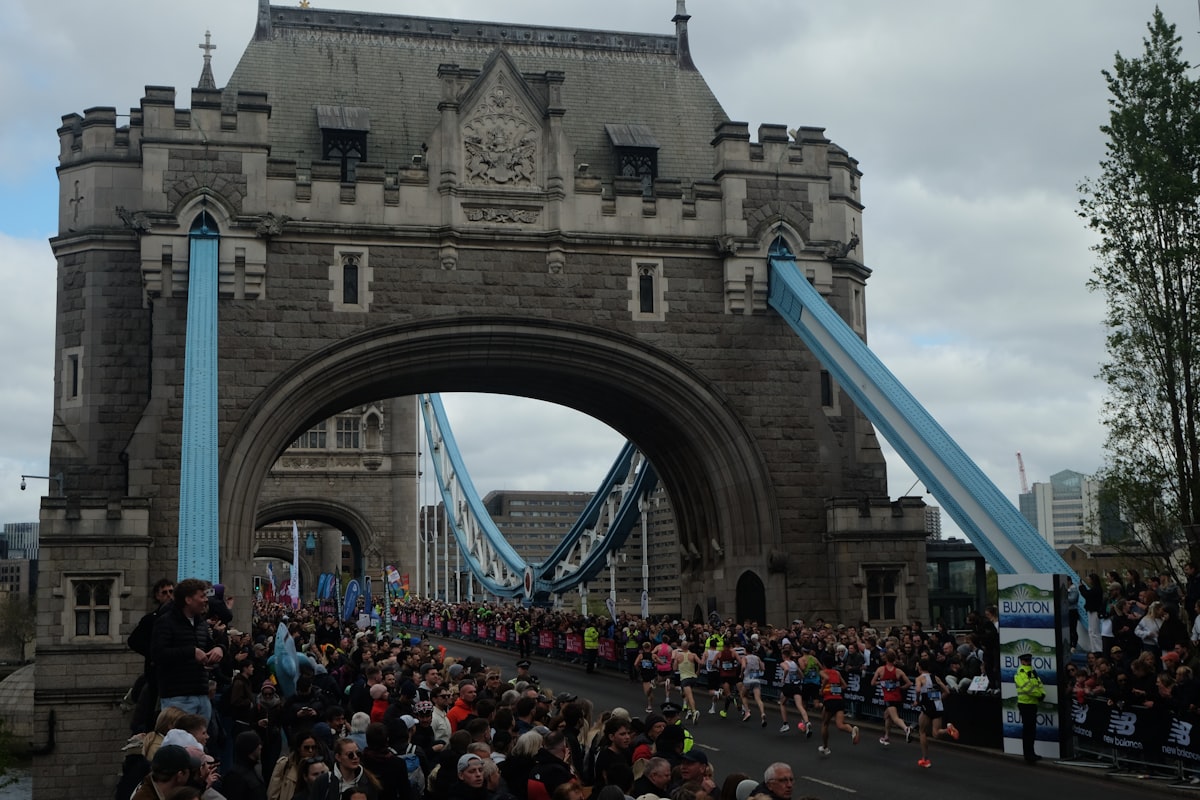
Approaching Mile 12, the course funnels runners onto the iconic Tower Bridge. The wall of sound from the spectators creates a massive psychological boost, but it also triggers a physiological risk. This sensory overload stimulates the sympathetic nervous system, increasing your heart rate and accelerating glycolysis—the breakdown of carbohydrates for fuel.
Physiological Insight: The Adrenaline Trap. When your sympathetic nervous system spikes due to crowd noise at Tower Bridge, your body shifts its metabolic fuel mix away from lipid oxidation toward rapid glycogen utilization. Spikes in heart rate, even without an increase in pace, can cause you to cross your aerobic threshold, depleting precious glycogen reserves that cannot be replenished mid-race. Maintain your target power or heart rate zone despite the crowd intensity.
To maximize glycogen sparing, you must actively practice cognitive dissociation or structured breathing patterns during this high-energy segment. Keep your gaze focused forward, drop your shoulders to release tension, and monitor your real-time biometric data (such as power output via a footpod or heart rate) rather than relying on perceived exertion, which is easily distorted by the crowd.
Canary Wharf and the Docklands: Biomechanics of Constant Turning
Between miles 15 and 20, the course winds through the high-rise canyons of Canary Wharf and the Isle of Dogs. This section presents two distinct challenges: erratic GPS tracking due to the urban canyon effect, and a high frequency of sharp 90-degree turns. These turns disrupt your forward momentum, requiring repetitive deceleration and acceleration phases.
Every time you decelerate to round a sharp corner and accelerate back to race pace, you engage the lactate shuttle mechanism to clear the temporary accumulation of lactate in your working muscles. To minimize this energy cost, run the tangents diligently. Smooth out the turns by taking a wider, more gradual arc where safe, and maintain a consistent torso posture to stabilize your pelvis against lateral forces, preserving your running economy.
For 2026, with the integration of advanced real-time pacing telemetry, relying strictly on GPS pace inside Canary Wharf is a recipe for pacing disaster. Switch your watch display to show elapsed lap time or utilize a reliable footpod sensor that measures cadence and stride length directly, bypassing satellite interference entirely.
| Course Segment | Key Physiological Challenge | Biomechanical Strategy |
|---|---|---|
| Miles 1-3 (Blackheath Descent) | High eccentric quadriceps loading and muscle micro-damage | Increase cadence, avoid overstriding, and land with midfoot strike |
| Mile 12 (Tower Bridge) | Sympathetic nervous system spike / accelerated glycogen depletion | Practice deep diaphragmatic breathing; pace by target heart rate/power |
| Miles 15-20 (Canary Wharf) | GPS disruption and lateral muscle fatigue from sharp turns | Run the tangents, stabilize the pelvis, and switch pacing to RPE/footpod |
| Miles 22-26.2 (The Embankment) | Accumulated neuromuscular fatigue and rising ground contact time | Drive arms dynamically, focus on quick step-off, and utilize lactate shuttle |
Frequently Asked Questions
Race with your
Inner Circle.
Create custom races and hear your friends' voice notes play automatically as you run. Real-time motivation from the people who matter most.